Can the ‘traditional’ view of sexuality ever be plausible?
 I'm oftentimes intrigued by those who fence that the church building'due south stance on sexuality—which usually ways the church building'south traditional opposition to seeing same-sex sexual unions every bit equivalent to male-female marriage—as an obstacle to mission. They are quite correct that nearly people beyond the church look at this aspect of its teaching with more than or less bare blindness. Just this stumbling block is really pocket-sized compared with the thought of believing in a crucified man being raised from the dead and offering a physical embodiment of the supreme creator of the universe. It'southward just worth putting these things in perspective!
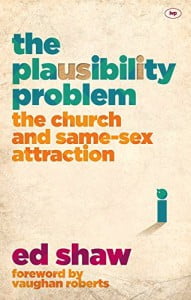
But Ed Shaw is quite right, in his new book The Plausibility Problem, that church's 'traditional' teaching on sexuality—sex within male-female marriage, abstinence without—looks increasingly implausible to people within the church building, as well as those outside. He introduces usa to 'Peter', a immature Christian man who is same-sex attracted, and 'Jane', an older divorced woman who has fallen in love with another adult female at work. Portraying their situations sympathetically, he highlights the problem:
Information technology is the Peters and Janes in our churches who are causing many evangelicals to lose their confidence in the Bible'due south teaching on sexual activity and marriage. It is the real people similar them who are tempting an increasing number of evangelicals to 'go liberal' on homosexuality. You might exist i of them. How tin yous expect Peter in the eye and deny him sex forever? How tin we enquire Jane to turn her back on the ane man relationship that has brought her joy? It just won't seem plausible to them. Information technology doesn't sound that reasonable to usa either. (p 21)
This shows why Shaw's volume is essential reading in our current context. If you want to see the church alter and accept same-sex matrimony on a par with the traditional understanding, you need to read this, considering it offers one of the best expositions of a genuinely evangelical pastoral response.
If yous are an evangelical (or of any tradition) who wants to see the church building maintain its 'traditional' teaching, you demand to read this because Shaw looks unflinchingly at the errors and missteps made by evangelicals and other 'traditionalists'. It does not make for comfortable reading, simply it is essential medicine.
Confronting, 'accepting' evangelicals, Shaw is clear that the cardinal texts mean what they say, and they exercise prohibit aforementioned-sexual activity sexual unions. (In a helpful appendix, he highlights why the 'revisionist' readings of these texts are themselves implausible.) But he is equally clear that trotting out this 'proof-text parade' no longer convinces anyone. Most interestingly, he finds the reasons for this not just in changes in culture, only in the failure of evangelical churches to put them in a plausible context of counter-cultural faithfulness to the gospel in several key areas. These failures mean that many churches seeking to be faithful to scripture are simply not offering a context for those who feel same-sex attraction a viable, personal space.
It'due south people, not theology, that seem to be powering the rejection of the traditional Christian ethic. It's Peter and Jane – and others like them – non the Hebrew and Greek. (p 23)
Shaw begins his word by offering a frank account of his own experience. He has never experienced anything other than same-sex attraction, and the book is punctuated by profoundly honest admissions of the struggles (as well equally the joys) of this. He pulls no punches near the unhelpful (fifty-fifty if well-meaning) 'help' he has received in some evangelical contexts. But he is also clear that the emergence of 'accepting' evangelicals has made his faithfulness to Scripture much harder.
Think for a moment of your greatest besetting sin. The thing God asks you non to recollect or do, but yous keep on thinking or doing. Consider how much your efforts to say 'No!' to it would be undermined if suddenly yous were told information technology wasn't wrong any more or, at the very least, if a few voices started to raise doubts in your mind. When next tempted, things would exist much more challenging, wouldn't they? Why resist thinking or doing that if it isn't really a sin whatever more? If Jesus doesn't heed – if Jesus would really approve!
Welcome to ane of the fiercest challenges of my life.
He then explores nine primal 'missteps' the church building has made which has undermined its plausibility on sexuality.
The commencement is to believe 'Your Identity Is Your Sexuality.' Shaw explains why he does not describe himself as 'gay', since he believes his identity is found primarily in who he is in Christ—or, better, who he is growing into being in Christ—rather than beingness found in his sexuality, let alone his sexual orientation. (See this post about Sean Doherty for a different twist on this, finding our identity as human beings of a particular gender, rather than a detail sexual orientation.)
It would be natural to presume that the principal target here would exist a revisionist or secular approaches to the issue—but Shaw offers an unusual twist. Throughout the book, he draws on writings from the Catholic, contemplative and radical traditions, but is also dependent on Puritan and Reformed writers. And his criticism hither is in the management of the Reformed—those who would constantly focus on Christians equally forgiven sinners, rather than redeemed saints.
Church meetings brainstorm with prayers of confession that – badly introduced or understood – give the impression that nosotros are sinners crawling dorsum to God in the promise of getting back into his good books. Nosotros don't remind each other plenty that our status permanently changed when nosotros first trusted in Jesus. That I don't ever need to clamber dorsum into God's presence – in Jesus, I now live in his presence all of the time. (pp xl–41).
 The 2d misstep is the conventionalities that 'Family Is Mum, Dad And 2.iv Children'. Here his critique is of the way that many evangelical churches have swallowed the doctrine of the nuclear family unit, and completely neglected Jesus' radical teaching on the true nature of 'family unit' in the light of the kingdom of God.
He replied to him, 'Who is my mother, and who are my brothers?' Pointing to his disciples, he said, 'Here are my mother and my brothers. For whoever does the will of my Male parent in heaven is my brother and sis and female parent (Matthew 12:46–50).
It turns out that Jesus defines his family as those who follow him rather than those who are related to him.
He offers a moving and personal account of relationships in his church which take begun to make that a reality for him, and challenges others to exercise likewise.
The third misstep is the merits 'If You're Built-in Gay, It Can't Be Wrong To Be Gay.' Again, Shaw makes a surprising connection with church education, and our failure to exist faithful to biblical teaching on 'original sin', the idea that we are sinful because nosotros are human being, and we cannot assume that any aspect of who we naturally are is necessarily holy just because information technology is natural.
The 4th misstep is 'If It Makes You Happy, And so Information technology Must Be Correct!' Hither Shaw highlights the manner many evangelical churches are duplicate from the hedonism and materialism of our culture.
The fifth, 'Sexual activity Is Where Truthful Intimacy Is Establish', laments the lack of serious friendship in many of our churches, which actually causes issues all around related to sexuality:
Our sexual activity drives are not just lessened by sexual intimacy; they can be satisfied by non-sexual intimacy, past friendship too. My personal experience is that the power of sexual temptation lessens the more time I spend among friends with whom I am not-sexually intimate.
In exploring misstep half-dozen, 'Men And Women Are Equal And Interchangeable', he argues that Scripture has a radically egalitarian approach to the status of men and women, whilst consistently maintaining divergence. In defending the latter, he draw on scientific and cultural insights, on the utilise of male person-female marriage as an analogy with the relationship between God and humanity—and on some intriguing testimony.
Melinda Selmys is a aforementioned-sex attracted Christian who has been in sexual relationships with both a adult female (in the by) and a man (she's now married with children). 'That frank bafflement which inevitably sets in, in any heterosexual relationship ('Why on earth would he do that? I just don't understand . . .') never set in throughout all of the years that my girlfriend and I were together – naturally enough. Nosotros were both women, and we chose each other considering nosotros seemed to be peculiarly compatible women.' (p 93).
Misstep seven was the one I found most personally challenging: 'Godliness is Heterosexuality'. Here he highlights the manner that many evangelical parents long for their children to abound up heterosexual—to the point of paranoia—when their aspiration should be that their children grow into Christlikeness. The notion that heterosexuality is more godly inhibits real honesty about heterosexual sexual brokenness, then that many struggle on alone, not realising that others are struggling too.
Misstep eight 'Celibacy is Bad for You' highlights how evangelicals have lost the tradition of celebrating singleness.
In his first-class book on marriage, Christopher Ash poses this question: 'When did we last encounter a successful movie which portrayed a contented bachelor or spinster?' I never have. Have yous?… And that's true within the church also. When did we final hear a practiced sermon that promoted lifelong singleness? I never have. Have you?
This loss is astonishing not just in the calorie-free of the history of significant single Christian leaders, but almost of all in the light of Jesus' and Paul's singleness.
The last misstep, 'Suffering Is To Be Avoided' is peradventure the most challenging of all. Despite the fact that Jesus suffered, that he calls the states to endure, and that this was the consistent education of Paul and other early church leaders, nosotros appear to have forgotten it.
For some reason, in our generation, following Jesus is no longer about our cede and suffering. Western Christians take, mostly, stopped denying ourselves – nosotros now talk more about our right to be ourselves. Our Christian lives are more about self-gratification – seemingly denying the being of Jesus' words here. They are a continuation of our previous lives, with a thin Christian veneer: just being nicer to a few more than people. (p 118)
If this was my statement, I think at that place are a few things I would have done differently. Some of the short chapters clearly belong together. 'If Information technology Makes You lot Happy, And so Information technology Must Exist Right!' is almost exactly the flip side of the coin 'Suffering Is To Exist Avoided', and the three chapters 'Family Is Mum, Dad And ii.four Children', 'Sex Is Where True Intimacy Is Plant' and 'Godliness is Heterosexuality' offer a comprehensive critique of Western Christian understandings of sexuality and marriage.
There were also i or two points where I think I disagreed with Shaw. If sexual orientation were found to be genetic, I think it would be much harder to distinguish it from (for example) racial identity, and much easier to say that the Bible is simply wrong. In fact I don't think that is ever going to happen, since 'orientation' is itself a construct of modernity and dependent on a especially socio-cultural outlook in a way that racial identity is not. He tackles the question of what is natural through the doctrine of original sin; I recall it is possible to achieve the same through the much broader theological language of fallenness. And I am non sure I would depict the purpose of marriage as giving a foretaste of the marriage of heaven and globe (as theology from above); it is enough to notation that it is a cardinal metaphor which provides an analogy (as theology from beneath).
But Shaw does accomplish 3 of import things in this book. For 'traditionalists', he demonstrates that the argue almost sexuality is in fact about much more than this one issue. That means that, if 'traditionalists' are going to 'win' the argument, they are going to accept to become their house in lodge on a whole range of other issues—and would probably be better off non using that label for themselves.
Secondly, for 'revisionists', he demonstrates that the debate well-nigh sexuality is in fact virtually much more than than this one event. This means that, if 'revisionists' are going to 'win' the argument, they are going to have to persuade the church to modify on a much wider range of theological problems than sexuality alone—our agreement of fallenness, social constructions of sexuality, and the role of discipline and suffering to proper name but a few.
Thirdly, Shaw demonstrates that this is, in fact, a crucial issue for the church building, and one nosotros would exercise well to attend to—and he does this with an extraordinary depth of personal openness and honesty. On reading this, I felt I had really encountered the author (whom I take met briefly), and not but a set of arguments. Shaw presents his case with a personal integrity that it is hard to exist unmoved past. In the terminate, the book awakened in me a fresh passion to live by the radical and nevertheless plausible demand to follow Christ with renewed commitment and free energy.
Afterwards returning to his example studies of 'Peter' and 'Jane', and what his comments might imply for them, Shaw concludes with a striking final observation:
Instead of keeping very silent on the upshot of homosexuality, hoping to avert all of the controversy that information technology brings u.s.a., we should brainstorm to see both the people who experience information technology and the controversy that information technology brings as a gift to the church. A divine souvenir, considering it's just what we needed at this time in our history to help us run across the whole series of tragic missteps nosotros have taken, to the detriment of us all, every bit well equally to the detriment of the world we are trying to reach.
Throughout church history, wonderful theological clarity has come up out of divisive theological controversy…And so the current controversies over sexuality should excite rather than dismay us – it is from times of profound disagreement that our Sovereign God has oftentimes brought a return to a radical biblical clarity in the church's theology and practice.
I have a sneaking feeling that he might well be right.
You can learn more about Ed's personal story on the Living Out website.
Statement of interest: I was provided with an advance copy of the volume The Plausibility Trouble: the church and same-sex attraction by Ed Shaw, published by IVP xixthursday February 2015, electronically and in print.
Much of my work is done on a freelance basis. If you lot have valued this post, would you considerdonating £1.20 a month to support the product of this blog?
If you enjoyed this, exercise share it on social media (Facebook or Twitter) using the buttons on the left. Follow me on Twitter @psephizo. Like my page on Facebook.
Much of my work is washed on a freelance footing. If you have valued this postal service, y'all can make a unmarried or echo donation through PayPal:
Comments policy: Good comments that appoint with the content of the postal service, and share in respectful debate, tin can add real value. Seek showtime to empathise, then to be understood. Make the most charitable construal of the views of others and seek to learn from their perspectives. Don't view debate as a conflict to win; address the argument rather than tackling the person.
Source: https://www.psephizo.com/sexuality-2/can-the-traditional-view-of-sexuality-ever-be-plausible/
0 Response to "Can the ‘traditional’ view of sexuality ever be plausible?"
Post a Comment